Teaching > Cognizant
Trained up whilst locked down: Australian graduates excel with remote learning
By Steven Burrows, Senior Learning Executive, Cognizant Academy — Fri, Aug 20, 2021
Cognizant Academy Australia has just completed its first graduate intake since the start of COVID-19. Steven Burrows and Peter McDonald from Cognizant Academy Australia organized the program and delivered the training. In this article, Steven shares his experiences with the program design, curriculum, special events and remote learning.
Introduction
The graduate training program (also known as “Generation Cognizant”, or “GenC” for short) took a break in Australia in 2020 as COVID-19 was emerging. The previous intakes from 2018 and 2019 comprised of combinations of Artificial Intelligence and Analytics (AIA), Cloud, Infrastructure and Security Services (CIS), Enterprise Application Services (EAS), Enterprise Engineering (EE) and Quality Engineering and Assurance (QEA) associates. For 2021 intake 1, Cognizant Australia had one Digital Experience (DX) associate and eight Enterprise Engineering (EE) associates to form a multidisciplinary group.
The program design leaned on Agile project management methodology, from which Scrum was chosen to model many of the weekly activities. Each Monday began with a Sprint Planning meeting to set the agenda for the week ahead. Here, Microsoft Planner was used as a lightweight Sprint Planner tool to document the tasks and the progress towards them. Then throughout the week, Daily Scrum meetings were used for associates to share their progress with the group and for the Scrum Master (i.e.: trainer) to update the progress on the Sprint Planner in a transparent manner. Then at the end of each week on Friday afternoons, a Sprint Review meeting was held for associates to demonstrate their progress against specific tasks given. This was followed by a short Sprint Retrospective meeting to share and document feedback about how the training for the week went.
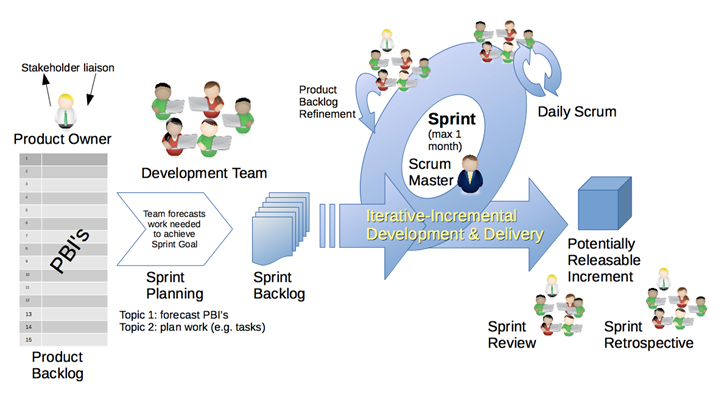

The activities were delivered via a combination of virtual instructor-led and blended modes of learning. Many of the instructor-led components comprised of the Scrum events described above. The other main instructor-led components were the “topic overview” sessions at the start of each day and the “afternoon check-ins” after each lunch break. The topic overview sessions were an opportunity for the trainers to discuss and demonstrate the topics with the associates, whilst the afternoon check-in sessions provided a chance for the associates to ask questions that they may have come up with throughout the day. That left the blended components as eLearning and practice, which were supported by the trainers.
Combined Curriculum
The combined curriculum for Digital Experience and Enterprise Engineering was created in consultation with the business units. The combined aspect was necessary in order to meet minimum group sizes for instructor-led training. Combining both groups together meant that all associates completed the same topics. Therefore, the topics chosen needed to be complementary in nature as much as possible.
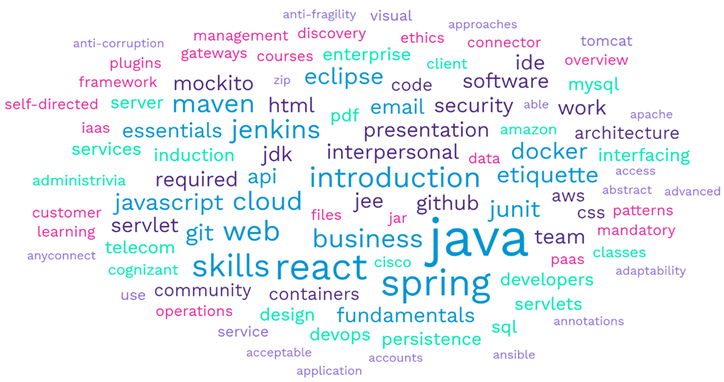
The topics were grouped into weekly sprints comprising of one or more topics per sprint including agile methods, head start on consulting, Java, databases, Maven, version control with Git, JUnit, CI/CD with Jenkins, ReactJS, DevOps, containers, cloud, security, and Spring among others. The eLearning content for each mostly comprised of courses from Cognizant’s organization-wide Udemy license. The courses ranged in length of anywhere from 30 minutes to over 40 hours.
Each sprint also had knowledge-based assessment and skill-based assessment. The knowledge-based assessments were multiple-choice assessments chosen from Cognizant’s enterprise learning management system (Cognizant Learn). The skill-based assessments utilized the Sprint Review meetings where associates were asked to each demonstrate one task each. For example for Java, associates demonstrated small assessments provided by the Udemy trainer. In order to promote maximum practice, associates were given the list of tasks early in the week, but the choice of task was delayed until the Sprint Review meeting itself and assigned via a random selection method. Other techniques to reinforce knowledge included presentation and teach back exercises.
Special Events
Numerous special events were planned throughout the training to make the graduate training program an enjoyable and varied experience. With the regular training cadence starting on the third day, the first special events utilized the first two full days to get the associates off to a good start. The first half of the first day was devoted to a People & Culture welcome, comprising of introductions to key personnel, expectations, Cognizant overview, business unit overviews, administration, and important other information to get started. The remainder of the first two days was devoted to a Cognizant Academy induction, which introduced accounts, equipment, IT support, facilities, administration, requesting software, key websites/apps, learning and development, compliance training, overview of the curriculum, agile methods, and a deeper introduction to Cognizant.


Once the training was underway, other activities staggered throughout the training included a resume writing workshop run by Talent Acquisition, a Cognizant Australia town hall, a combined Digital Experience and Enterprise Engineering town hall, one-to-one meetings with allocated mentors, and group meetings with business unit and account leaders prior to deployment to their projects.
Remote Learning
Australia has been no exception to COVID-19 restrictions, and Cognizant Australia’s accommodation of government restrictions had obvious implications to the running of the graduate training. Restrictions changed often and related to office closures, social distancing, mask wearing, and general health and safety among others. This meant that the decision to launch the program via remote learning had to be made shortly before the start, and this didn’t change for the duration of the program.
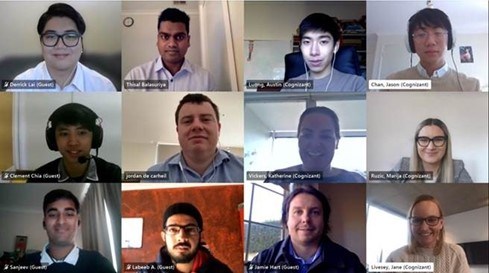
To promote engagement, associates were actively encouraged to use their webcams to feel connected throughout. Despite working from home, all group members demonstrated a positive attitude to the remote learning and program as a whole. The full group is still looking forward to a future opportunity to meet together in person when circumstances permit.
Conclusion
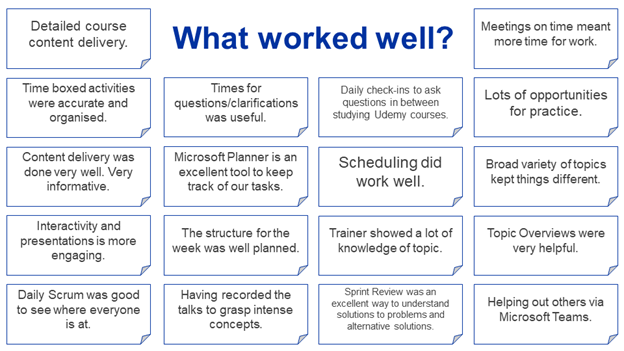
Towards the end of the training, all associates were allocated to projects to start within a few weeks of the conclusion of the training. The feedback received has generally been very positive and some examples captured from the Sprint Retrospective meetings are shared below. It is exciting to note that there is much more graduate training coming up in Australia including a larger second intake scheduled to run later in 2021. In addition, the graduate intake for 2022 is predicted to double or triple in size compared to 2021.
Steven and Peter wish to thank People & Culture (in particular Marija Ruzic and Katherine Vickers), Talent Acquisition (in particular Mantri Boange), Digital Experience leadership, Enterprise Engineering leadership, and account leadership among others for their combined efforts with Cognizant Academy and each other to make this program a success.