Teaching > Cognizant
Australian Graduates High Five with Five Curriculums Together
By Steven Burrows, Senior Learning Executive, Cognizant Academy — Thu, Oct 28, 2021
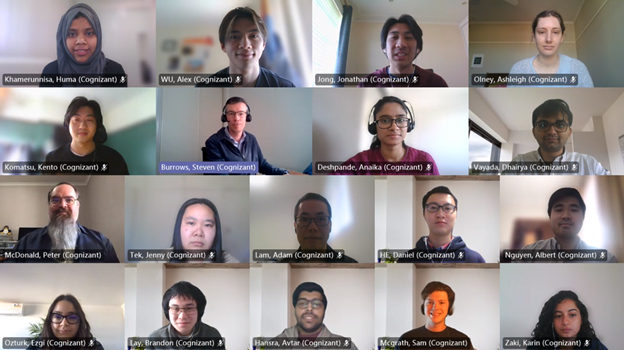
The second graduate intake has just been completed by Cognizant Academy Australia for the 2021 calendar year. The program design and training delivery was performed by Cognizant Academy Australia members Steven Burrows and Peter McDonald. This blog shares how the cohort ran regarding the group makeup, program design, overlapping curriculums, a design thinking workshop, and a shaky earthquake interruption.
Introduction
The second graduate training program for 2021 run by Cognizant Academy Australia (otherwise named “Generation Cognizant” or abbreviated to “GenC”) launched in late August 2021, and built on the successes of the June 2021 intake from just a few months earlier. This cohort increased the number service lines represented from two to five and the number of graduates participating from nine to sixteen. The full group comprised of four Data+ associates (Data+ specializes in data modernization and intelligent decisioning), one Digital Experience (DX) associate, eight Enterprise Application Services (EAS) associates (specializing in Salesforce), two Enterprise Engineering (EE) associates, and one Quality Engineering and Assurance (QEA) associate.
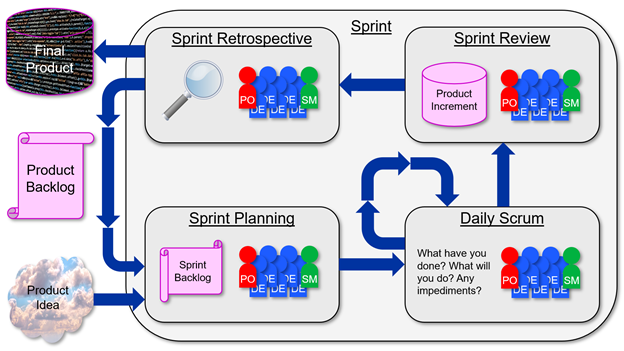
Like the previous intake, the program design modelled an Agile Scrum project management methodology. This meant that all graduates and trainers participated in all Scrum events for the weekly sprints. Each sprint began with a Sprint Planning meeting on Mondays to articulate the tasks for the week ahead. The tasks discussed in the meeting were recorded and maintained in Microsoft Planner as the chosen agile card wall. Throughout the week, updates and impediments were shared each morning during the Daily Scrum meetings. Then at the end of the week, each sprint concluded with a Sprint Review for associates to give practical demonstrations of their mastery of the learning materials. Immediately following this was the Sprint Retrospective meeting for collecting feedback, some of which is copied into this blog at the bottom.
Additional virtual instructor-led sessions that would not be considered Scrum events included topic overview sessions that explained and demonstrated the subject matter, and afternoon check-in sessions for questions and answers. This meant that self-paced courses done between the various events can be considered as a blended mode of learning given the above supports available.
Five Curriculums Together
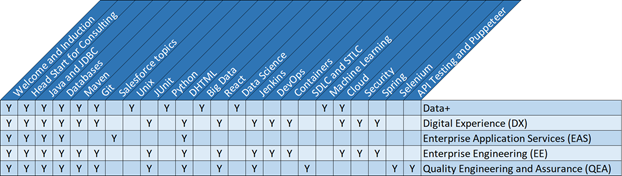
The curriculum for the five service lines was optimised so that any common component was done together. This increased group sizes and meant that virtual instructor-led training support could be widely provided. Each topic within the curriculum design was therefore completed by associates aligned to anywhere between one to five of the service lines. The self-paced courses within the curriculum were mostly sourced from our various strategic learning content partners.
The learning was reinforced by knowledge-based assessments and skill-based assessments for each sprint. The knowledge-based assessments were multiple choice assessments used by many of our associates around the world from our SumTotal enterprise learning management system, that we internally refer to as Cognizant Learn (CLearn). The skill-based assessments were given during the Sprint Review meetings to demonstrate skills learned. There was a lot of variation with some examples being: (i) teach back a summary of a behavioral topic; (ii) demonstrate a Java solution for an Udemy assignment; (iii) run, discuss, and critique pre-prepared SQL queries on a common database hosted by the trainer; and (iv) give group presentations on contemporary DHTML features, with different groups focusing on features from HTML, CSS, and JavaScript layers.
Design Thinking Workshop
A unique event that was run during this intake was a Design Thinking workshop, facilitated by Kim Van Wynendaele and Rhys Atkinson, with Peter McDonald acting as the project sponsor. The workshop was suggested by Peter during a working group meeting, which both Peter and Rhys attend, that focuses on future talent and ways of improving their experience. With the event being scheduled at the end of the program, this allowed the design thinking methodology to be applied to the problem of how the graduate training program could be improved in the future.
"Design thinking is a human-centered approach to innovation that draws from the designer’s toolkit to integrate the needs of people, the possibilities of technology, and the requirements for business success."
– Tim Brown, Executive Chair of IDEO
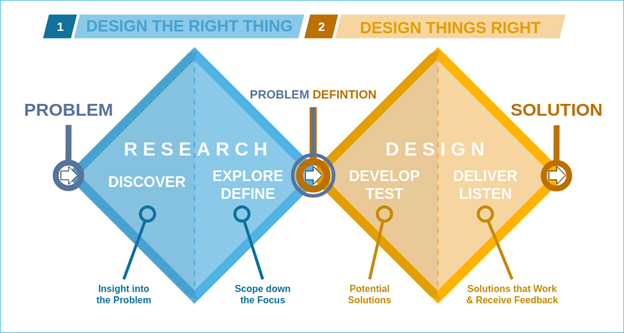
The workshop activities were framed around the "double diamond" methodology, which features two rounds of divergent and convergent thinking to develop solutions to the problem at hand. There were some great ideas about how to introduce opportunities to collaborate in small groups on sprint review activities, such as short hackathons during the formal training period to allow for additional small group collaboration, but also to allow for exercising innovation and application of the newly acquired skills from the training. There were also ideas about accelerated tracks for those graduates who come into the program further advanced in their knowledge and experience than others.

Another new feature for this intake was a series of guest-speaker sessions from members of the Salesforce community to provide additional subject-matter expertise. Salesforce provide their own training modules for preparing new practitioners to the various capabilities of the Salesforce platform and corresponding certification. We augmented this self-paced learning with Q&A and advice sessions led by SMEs from the Enterprise Application Services (EAS) Salesforce service line in Australia. The graduates found it very valuable talking with and learning from these experts during the sessions.
Other special events that ran during the graduate training program included a half-day welcome session from People and Culture, sessions lasting one-and-a-half days relating to orientation from Cognizant Academy, a resume writing workshop facilitated by Talent Acquisition, plus numerous opportunities for the graduates to meet with home managers, assigned mentors, service line leaders, and account leaders.
Earthquake Interruption Not Our Fault
Have you ever had a training session where the facilitator asked: "Please raise your hand if your house is shaking?" Well, that’s exactly what happened one morning during a daily graduate training connect. On Wednesday 22 September 2021, regional town Mansfield in the state of Victoria in Australia experienced a 5.8 magnitude earthquake early in the working day. Being 180km by road from Melbourne and of a modest magnitude, the event did not cause loss of life or injury, but rather minor structural damage to some buildings only. Nevertheless, it was one of the largest earthquakes in recorded history in Australia, and it was experienced by everyone participating in the training based out of Melbourne. In the end, the earthquake wasn’t shocking enough to make anyone in the training want to run out the front door of their house, but it was certainly a memorable talking point henceforth.
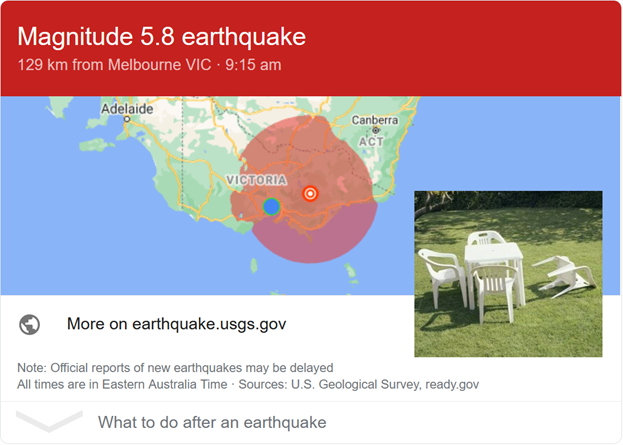
Apart from the five Melbourne group members, there were others who did not feel the earthquake, including the nine group members located in Sydney. We also had one in Canberra pending relocation to Melbourne, and one in Brisbane pending relocation to Sydney, when COVID-19 movement restrictions allow for both. This geographic spread combined with the health requirements imposed by the highly contagious Delta-variant of COVID-19 meant that this intake unsurprisingly ran by remote learning, like the previous intake. With everyone involved already being well adapted to remote working due to lengthy government restrictions, this was our “new normal” way of training together, and all group members approached the remote learning with a positive mindset.
Conclusion
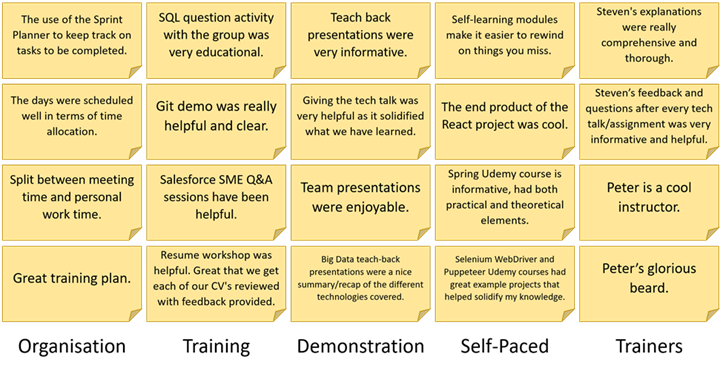
Onboarding and transition to account work commenced shortly after the conclusion of the formal training period and stretch learning assignments were provided to help fill some gaps. The stretch learning assignments included domain learning, technical deep dives, and industry certification. We also finished collection of feedback across the program, which included quantitative feedback scores that exceeded all benchmarks coming from regular surveys (below). In addition to this, we also captured qualitative feedback including comments documented during Sprint Retrospective meetings (also below).

Steven and Peter from Cognizant Academy Australia thank People & Culture, Talent Acquisition, Cognizant Consulting, service line SMEs and leadership, and account leadership among others for helping to make the program successful. We are looking forward to the next graduate intakes in 2022, which are predicted to be much larger and more numerous than those in 2021.