Teaching > Cognizant
Australian Graduate Training with a Rare and Special Guest
By Steven Burrows, Senior Learning Executive, Cognizant Academy — Wed, Jun 15, 2022
The first graduate intake has just been completed by Cognizant Learning & Development Australia for the 2022 calendar year. The program was designed by Cognizant Learning & Development Australia members Steven Burrows and Peter McDonald and the training was also delivered by Steven Burrows. This blog introduces the 11 graduates and shares how the cohort ran regarding early learning, day one excitement, program design, topic coverage, engagement opportunities, the graduation ceremony, and feedback received.
Early Learning
For the first time, we were able to offer our graduates an "early engagement experience" via an Udemy platform that is separate from that used by Cognizant tenured associates. The idea was to give the graduates some optional learning opportunities whilst waiting for their first day to start. The topics were designed to complement the regular training program and not otherwise affect progress. The topics chosen amounted to around 10 hours of learning for each service line and included an introduction to Cognizant, introduction to service lines, the graduate training program, consulting skills, and some short technical topics.
Special Guest on Day One
This intake for our graduate training program (otherwise named "Generation Cognizant" or abbreviated to "GenC") launched on Monday 11 April 2022 and ran through to Wednesday 25 May 2022. The full group that joined comprised nine Enterprise Engineering (EE) associates, and two Quality Engineering and Assurance (QEA) associates, which were all Melbourne-based. This allowed for selected parts of the training to be done in person, as a geographically dispersed cohort would have required a pure virtual delivery model instead.
The graduates were greeted with an extraordinarily busy office on their first Monday due to special events surrounding the Melbourne Grand Prix long weekend that ran from Friday 8 April 2022 to Sunday 10 April 2022. This was due to Cognizant’s new Aston Martin Formula One sponsorship, with its debut race only shortly prior on 28 March 2022 in Bahrain. This meant lots of celebrations in Sydney and Melbourne both before and after the long weekend, which attracted hundreds of local associates for back-to-base events.
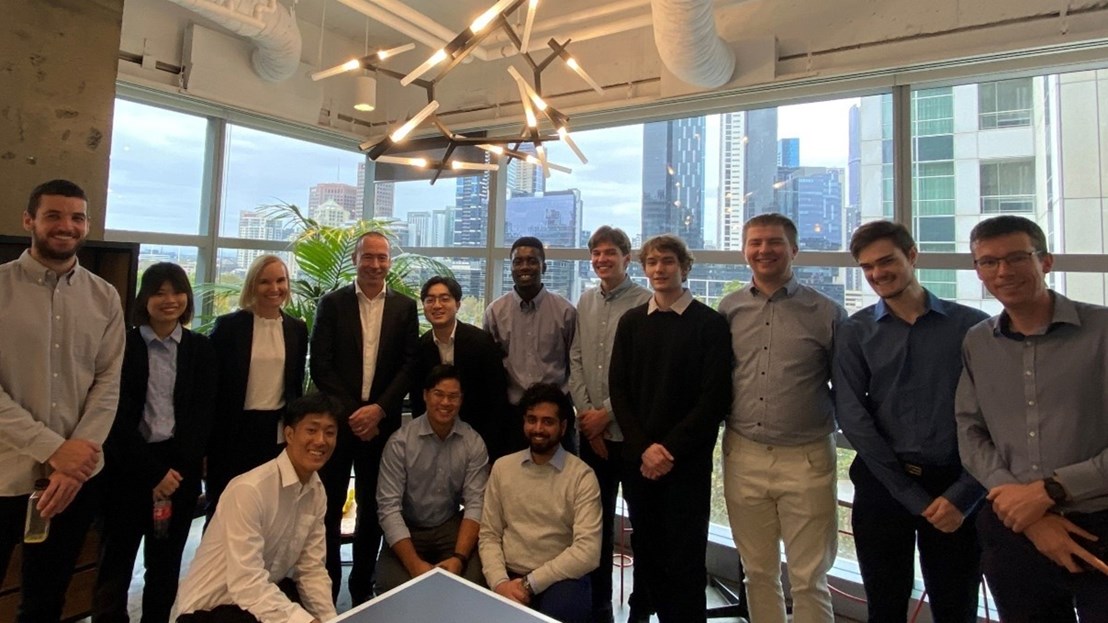
Joining the celebrations in Melbourne and Sydney was none other than Cognizant’s chief executive officer Brian Humphries, hosted by country head Jane Livesey. Brian addressed the associates in town hall events at both locations, speaking of Cognizant’s history, vision, and growth among others. He also addressed the graduates citing his journey from graduate to CEO and the career journey that got him where he is today. After the local town hall, the graduates also had a chance to speak with Brian directly in a group huddle off to the side. It’s not every day that the CEO of a company with 330,000+ associates visits locally, so this was certainly a rare and special opportunity! The photo at the top of this article is a record of the meeting.
Program Design
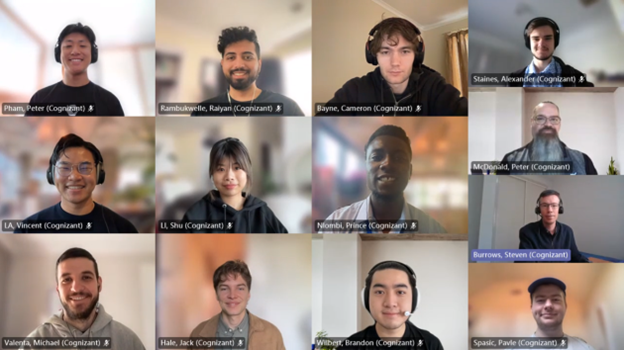
Like the two intakes from 2021, the program design modeled agile project management techniques using agile scrum-like events. This meant that the graduates and the trainer participated in all agile events for each sprint, which were five working days in length. Each sprint began with a sprint planning meeting to articulate the tasks for the sprint ahead. The tasks discussed in the meeting were recorded and maintained in Microsoft Planner as the chosen agile card wall. Throughout the sprint, updates and impediments were shared each morning during the daily scrum meetings. Then at the end of the sprint, a sprint review was conducted for associates to give practical demonstrations of their mastery of the learning materials. Immediately following this was the sprint retrospective meeting for collecting feedback.

.png)
Additional instructor-led sessions included topic overview sessions that explained and demonstrated the subject matter and afternoon check-in sessions for questions and answers. All sessions were either in-person or virtual, and the mode sometimes changed due to COVID-19 contingencies. Beyond the instructor-led sessions, the self-paced courses were completed in between, which can be considered as a blended mode of learning given the above supports available.
Topic Coverage
The Australian GenC curriculums had been optimized so that the common topics were done together. This increased group sizes and allowed for more instructor-led training that could be provided otherwise. In the case of this intake, the Enterprise Engineering (EE) and Quality Engineering and Assurance (QEA) topics overlapped by around 80%, meaning a lot of commonalities could be utilized. Also, the learning was supported by self-paced courses that were mostly sourced from our learning content partners including Udemy.
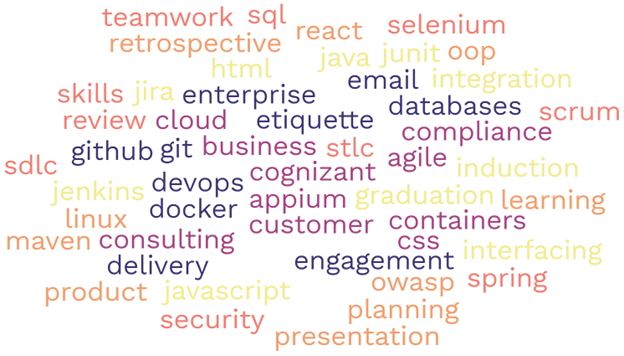
The learning was reinforced by knowledge-based assessments and skill-based assessments for each sprint. The knowledge-based assessments were multiple-choice assessments hosted by our enterprise learning management system. The skill-based assessments were conducted during the sprint review meetings to demonstrate what the associates had learned in the preceding sprint. Examples of sprint review topics were: (i) teach back a summary of a behavioral topic; (ii) demonstrate a Java solution for an Udemy assignment; (iii) run, discuss, and critique pre-prepared SQL queries on a common database hosted by the trainer; and (iv) give group presentations on contemporary DHTML features, with different groups focusing on features from HTML, CSS, and JavaScript.
Engagement Opportunities
Members from both Enterprise Engineering (EE) and Quality Engineering and Assurance (QEA) had a "meet your service line" connect, where Forge Villella and Manjiri Shahane hosted the graduates respectively. These leaders provided an overview of the service line, types of work, community engagement, clients, projects, and a forward look at deployment opportunities. Graduates also had time to ask their questions, and they appreciated knowing more about work after the graduate training program.
Other special events that ran during the graduate training program included a half-day welcome session from People and Culture, sessions lasting one-and-a-half days relating to induction from Learning & Development, a resume writing workshop facilitated by Talent Acquisition, plus numerous opportunities for the graduates to meet with home managers and assigned mentors.
Graduation Ceremony
Like the Udemy early engagement experience, we also ran a graduation ceremony for the first time. A large group of stakeholders was invited including senior leadership, service line leaders, corporate functions, the graduates themselves, and others. The one-hour event covered the program design, program outcomes, experiences of the graduates (spoken by two of our graduates), notes from our leaders (including country head Jane Livesey), the awards ceremony, and acknowledgments.
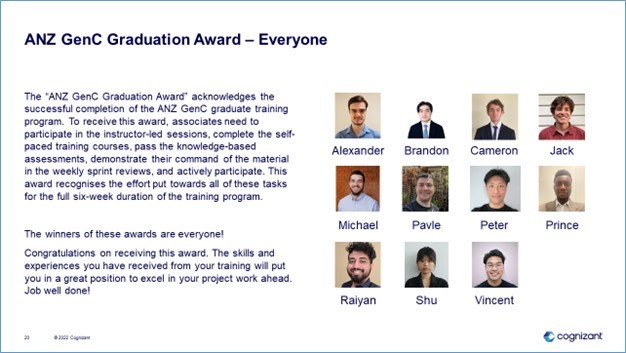
The awards comprised some individual awards for exceptional individual performance in areas such as attitude, communication, knowledge, and technical excellence. We also acknowledged the overall graduation from the training program, for which all members of the cohort completed. The expectations to graduate required participation in the instructor-led sessions, completion of the self-paced training courses, passing the knowledge-based assessments, demonstrated understanding of the material in the weekly sprint reviews, and active participation.
Conclusion
Learning & Development handed the baton to the service lines after the conclusion of the training, for the graduates to onboard and transition to their project work. Some stretch learning assignments were also provided so that any gaps could be filled in the intervening period. The stretch learning assignments included options for domain learning, technical deep dives, and industry certification.
We also finished the collection of feedback across the program. The quantitative feedback came from the per-topic feedback surveys, where the effectiveness of the instructor, courseware, environment, support, and overall rating was measured. The scores we received from the five-point Likert scale questions are summarised below. The same surveys also had a question on the Net Promotor Score (NPS), as a measure of customer satisfaction. The survey respondents were asked how likely they would recommend this training to their colleagues on a scale of 0-10. A great score of 57 was received for this metric.

The feedback also included a qualitative component collected from both the sprint retrospectives and the feedback surveys. Feedback about things that worked well from the sprint retrospectives included the clear weekly structure, hybrid working, MS Teams collaboration, Udemy teaching, variety of tools and programs, sprint review collaboration, networking opportunities, and hands-on learning among others. We also collected a lot of feedback from the feedback surveys, including one stand-out comment relating to how the support of the business in forming complementary cohorts has an impact on the overall experience. This was an aspect this respondent liked:
"Meeting everyone. Everyone was very nice and welcoming and getting to know the variety of people and people in different positions is nice, and it is good to understand who is who in the office. Regarding the group aspect, I hear we were fortunate to all be in similar service lines and locations, but it seemed to have helped a lot and seems it will help a lot down the line too. It made it easier to engage with each other, and not separate naturally into groups of what everyone was doing."
Steven and Peter from Cognizant Learning & Development Australia thank Talent Acquisition, Talent Supply Chain, People & Culture, service line leaders, account leaders, senior leadership, and others, for helping to make the program successful. We are now anticipating and looking forward to three more graduate intakes in 2022.